A Masai Mara honeymoon safari, designed for two
A Masai Mara honeymoon with us is the Mara you have seen on television — lions on the open plains, the Great Migration crossing the Mara River, a hot-air balloon at first light — seen from a tent with a wall of glass. Then we add what most Mara trips miss: a few nights in a private conservancy next to the reserve, and a slow finish by the Indian Ocean. It is one nonstop flight from Mumbai.
Plan our honeymoonTell us your wedding date — we'll design the rest
Leave your details and a honeymoon designer will message you on WhatsApp shortly to hear about the two of you. We do the research, you choose.
The honeymoon that wakes you at five
Most honeymoons are about stillness. A Masai Mara honeymoon is about attention. You are up before the sun with a flask of coffee, watching a lioness lead her cubs across the track, and by eleven you are back in a tent that looks out over the plains with nothing to do until tea. Two drives, a long middle, a fire at night. And the Mara is closer than people think: a single nonstop flight from Mumbai to Nairobi, then an hour in a small plane.
Yes, you will see the Masai Mara itself, the 1,510 square kilometres of reserve that every safari photograph comes from, and in July to October the river crossings. It suits couples who are curious and like being outdoors. It suits fewer couples who need a spa every afternoon or dread an early alarm; we would send them to the Maldives first. Camps are small and unfenced, and our most intimate one has six tents. Privacy comes built in.
The classic mistake is the road circuit: Nairobi, Amboseli, Lake Naivasha and the Mara in a week, with most of each day in a minivan. For a honeymoon we fly, and we choose two places, not four. The second mistake is staying only inside the reserve in high season, sharing every sighting with twenty vehicles. So we pair the reserve with a private conservancy — private land bordering the reserve, with the same animals, a cap on vehicles, and night drives and walks allowed.
What a Masai Mara honeymoon looks like
- Day 1Nairobi to the Masai Mara
Off the night flight, onto the plains
The overnight Kenya Airways flight from Mumbai lands in Nairobi at dawn. We meet you at arrivals, drive you across to Wilson Airport, and by late morning a light aircraft is setting you down in the Mara, about an hour later. Lunch on the deck, then your first drive at four.
- Day 2Masai Mara Reserve, Mara Triangle
The Mara everyone pictures
Three nights at Angama Mara, its glass-fronted tents on the escarpment about 300 metres above the Mara Triangle, the western part of the reserve along the Mara River. Long drives down onto the open plains for lion, elephant and cheetah. From July, the herds of the Great Migration gather at the crossing points below the camp.
- Day 3Over the Masai Mara
The balloon at first light
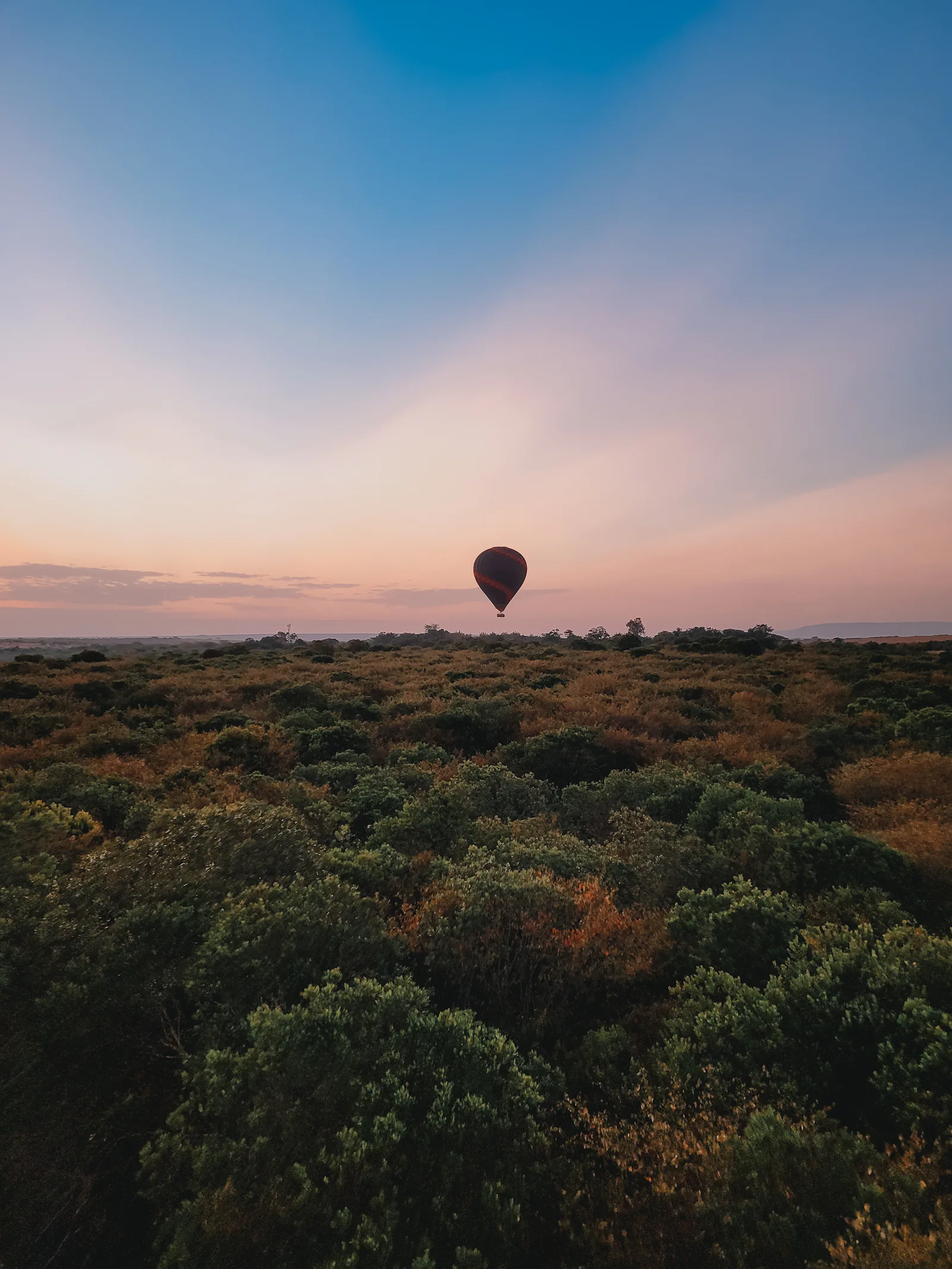
Lift-off in the dark, an hour drifting low over the river as the plains wake, then a champagne breakfast where the basket lands. In the afternoon, a picnic on the kopje beside the camp where scenes of Out of Africa were filmed, with the whole Mara laid out below you.
- Days 4-6Olare Motorogi Conservancy
The same Mara, to yourselves
A short flight to Mahali Mzuri, Richard Branson's camp in a private conservancy bordering the reserve. A tented suite with a floor-to-ceiling window onto the valley. Vehicles are capped, so a lion pride at breakfast is shared with no one. A morning walk with a Maasai guide, a night drive with a red spotlight, and dinner laid out under an acacia.
- Days 7-9Lamu, on the Kenyan coast
From the bush to the Indian Ocean
About an hour and a quarter from Nairobi to Manda, for Lamu, an old Swahili island town with no cars. A boat across the channel to The Majlis, a sunset sail on a wooden dhow, and a morning in Lamu Old Town, a UNESCO World Heritage Site since 2001, with its carved doors and rooftop lanes.
- Day 10Manda and home
One last tide
A slow breakfast on the terrace, a final swim, and a morning flight back to Nairobi. The evening Kenya Airways flight lands in Mumbai after midnight, which means one full night of sleep at home before the world returns. We keep this last day empty on purpose.
Three ways to honeymoon in the Masai Mara
The minimoon — 5 Nights
Mara Triangle (2) → Naboisho Conservancy (3)
Pure safari for couples with a week. The reserve and a dawn balloon first, then six tents at Saruni Leopard Hill in a private conservancy, with roofs that open to the sky.
The classic — 10 Nights
Mara Triangle (3) → Olare Motorogi Conservancy (3) → Lamu and Manda (4)
Our signature shape. The Masai Mara reserve, then the same plains from a private conservancy next door, then the dhows and dunes of Lamu, so the journey ends slower than it began.
The grand honeymoon — 14 Nights
Mara Triangle (3) → Naboisho Conservancy (3) → Mara North Conservancy (2) → Seychelles (6)
Three corners of the Mara, then Kenya Airways' nonstop from Nairobi to Mahé for Praslin and La Digue.
What we would plan for the two of you
THE BALLOON AT FIRST LIGHT
You lift off in the dark and watch the Mara wake beneath you, river mist burning off, giraffe throwing long shadows. About an hour aloft, then champagne breakfast on the plains where the basket lands. We book it for the third morning, once the jet lag has gone.
See the experienceTHE RIVER CROSSING
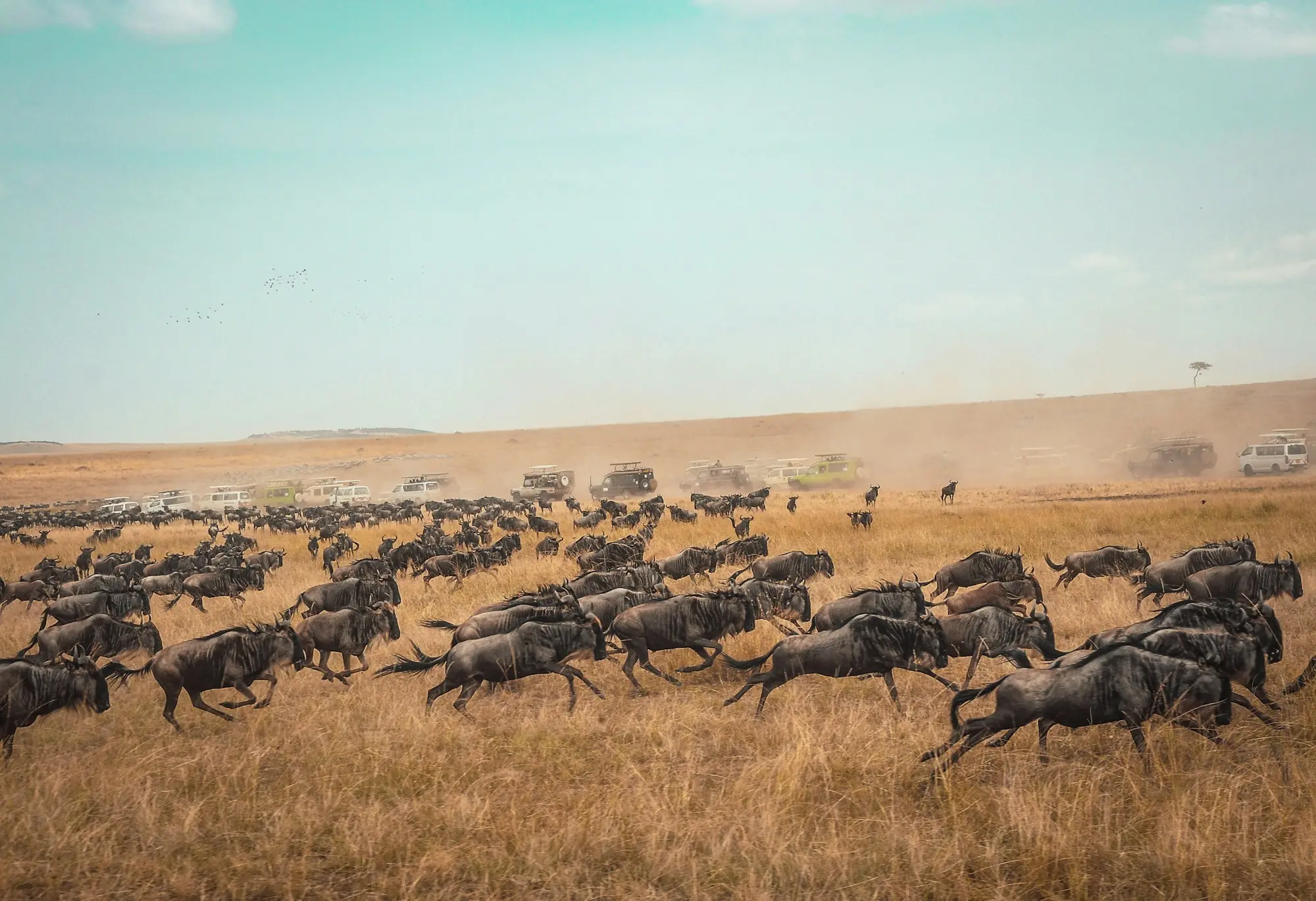
Between July and October the wildebeest reach the Mara River and gather on the bank, sometimes for hours, before the first one jumps. Your guide reads the herd and positions the vehicle. Crossings are never guaranteed on a given day, which is why we give the reserve three nights.
A PICNIC FROM OUT OF AFRICA
Beside Angama Mara is the kopje, a rocky outcrop on the escarpment, where scenes from Out of Africa were filmed. Lunch is laid out for two on the edge, the plains of the Mara Triangle running to the horizon 300 metres below.
A ROOF THAT OPENS TO THE STARS
At Saruni Leopard Hill in Naboisho, the roof of your tent opens at the touch of a button. You fall asleep beneath the southern sky, with no lights for miles and hyenas calling somewhere down the valley. It is the night couples talk about first.
WALKING WITH A MAASAI GUIDE
In the private conservancies you can leave the vehicle. A Maasai guide walks you out at seven, reading tracks in the dust and naming the plants the Maasai use as medicine. You see the Mara at walking pace. The national reserve does not allow it.
A SUNSET DHOW ON THE LAMU CHANNEL
A wooden dhow with a cotton sail, a captain from Lamu, cold drinks and the mangroves of Manda going dark on one side. The boat drifts past Shela as the call to prayer carries across the water. Fish grilled on board if you stay out late.
Honeymoon hotels in Masai Mara we trust
Angama Mara
Two camps of fifteen tented suites each, about 300 metres above the Masai Mara reserve. Every tent has a wall of glass facing the plains, so the morning balloons drift past at eye level and you watch the Mara from bed. Its name comes from the Swahili for 'suspended in mid-air'.
Mahali Mzuri
Richard Branson's camp: twelve tented suites in a private conservancy of about 33,000 acres bordering the reserve, reopened in June 2025 after its first full redesign. New floor-to-ceiling windows mean you watch the valley from bed, and the heated infinity pool makes the middle of the day as good as the drives.
Saruni Leopard Hill
Six tents beneath an old fig tree, close to three waterholes. Each has a roof that opens electronically so you can sleep under the stars, and an outdoor shower. Night drives and walking safaris are part of every day. It is the most intimate camp we use in the Mara, and the one couples remember.
Elephant Pepper Camp
A small classic tented camp with two honeymoon tents at either end, each larger than the rest, with a private veranda over the plains where dinner can be served for two. Unfenced and unpretentious, it is the camp for couples who want the bush close. Best from July to October.
The Majlis
On the Manda shore, facing the village of Shela across the Lamu Channel, and reached only by boat. White walls, carved Swahili doors, a beach in front and the dhows passing all day. Ask for a suite facing the water. The right place to recover from five early mornings on safari.
When to go on your Masai Mara honeymoon
Dry, warm and quiet, with short grass that makes the big cats easy to find. It falls straight after a November, December or February wedding, and the coast is at its best. The migrating herds are in Tanzania, but the Mara's resident lions, cheetah and elephant are superb.
The long rains. Tracks turn to mud, some conservancy camps close for several weeks, and the coast is wet and humid. In 2024 the rivers flooded and several camps along them shut. We do not plan honeymoons here in these months.
The wildebeest arrive from the Serengeti and cross the Mara River, the most dramatic sight in Africa and the busiest season. June is green and quiet before it. Camps book ten to twelve months ahead. Worth it for couples who can marry, or wait, until summer.
Afternoon showers that pass quickly, green plains and very few vehicles. A good choice for couples who marry in late October or early November and want to leave at once. We keep one spare afternoon in the plan for weather.
Planning a Masai Mara honeymoon from India
Flights from India
Kenya Airways flies nonstop from Mumbai to Nairobi in about six and a quarter hours. The overnight departure lands at dawn, in time for a morning light aircraft to the Masai Mara, so no night in Nairobi is needed. From Delhi, Bengaluru and other cities we connect to the Mumbai flight or route one-stop through Dubai or Doha. Kenya is two and a half hours behind India, so there is no real jet lag.
Getting around
Small aircraft from Nairobi's Wilson Airport reach the Mara airstrips in about an hour, instead of most of a day by road, and Manda, for Lamu, in about an hour and a quarter. Luggage must be soft bags within a strict weight limit, so we send a packing list and store anything extra in Nairobi. In Lamu, everything moves by boat, on foot or by donkey.
Vegetarian & Jain food
Kenya is one of the easiest safari countries for vegetarians. Nairobi has a large Indian community, and camp chefs are used to vegetarian guests; with a brief sent at booking, dal, rotis and fresh vegetables appear without fuss. Jain meals, without onion, garlic or root vegetables, are manageable in the camps with two weeks' notice. On Lamu the cooking is Swahili and coconut-based, with plenty that is vegetarian.
Pair it with
The Seychelles is the natural partner. Kenya Airways flies nonstop from Nairobi to Mahé in about three and a quarter hours, so the Mara gives way to granite beaches, the Vallée de Mai on Praslin and bicycles on La Digue. It is the finish we choose when the couple wants a beach resort more than a Swahili town.
More for your Masai Mara honeymoon
The places
Pairs beautifully with
What travellers say
“Really amazing experience with their trip planning and in trip assistance. Kriti and Tushika have been very helpful throughout the trip. Always available and providing the best experience throughout. Our best wishes to the entire team”
“TheLuxeTrails made our California vacation effortless. Their attention to detail was impressive — beautiful accommodations, excellent itinerary planning, and genuine flexibility when we decided on an impromptu road trip. They arranged our car within hours and provided local expertise that transformed our trip.”
“We had a great experience in uk . The team is very helpful and they are assisting us till the end of the trip . Overall my experience with luxe trail is amazing”
“Highly personalised trip with great coordination throughout! Definitely recommended”
A first conversation
Tell us a little below. A travel designer replies personally on WhatsApp — no cost and no commitment.
The discovery call
An unhurried call, free of charge, where you do most of the talking: your pace, what you love, the date that matters.
Your proposal, presented
A considered proposal walked through with you — the route, each named hotel, the private moments, and what we would skip.
Real itineraries through Masai Mara
Tell us about your Masai Mara honeymoon
Your wedding date, how long you have, and what the two of you love. A travel designer reads every enquiry personally and replies on WhatsApp.
Questions, Answered
Do you offer Masai Mara packages?
We don't sell fixed packages — every honeymoon is designed from scratch around your dates and the two of you. If you have been comparing Masai Mara packages, the difference is in what they leave out: most drive from Nairobi and stay in large lodges inside the reserve. We fly you in, choose small camps, add a private conservancy and a dawn balloon, and end on a beach.
Is the Masai Mara good for a honeymoon?
Very, for couples who want a honeymoon with stories in it. Small camps give you privacy, tents with views from bed, a dawn balloon and dinners in the bush. It is one nonstop flight from Mumbai to Nairobi and an hour by small plane. Couples who want to do nothing all day are better suited to the Maldives, or to a Mara trip that ends with a week by the sea.
What is the best time to see the Great Migration in the Masai Mara?
July to October, when the wildebeest arrive from the Serengeti and cross the Mara River. Crossings depend on rain and are never guaranteed on a given day, so we give the reserve three nights. Camps book ten to twelve months ahead. For a December to March honeymoon, the herds are in Tanzania, but the Mara's resident big cats are at their easiest to find.
How many days are enough for a Masai Mara honeymoon?
Ten nights is right: six on safari across the reserve and a private conservancy, then four by the sea on Lamu. Five nights works as a pure-safari minimoon. With fourteen nights we add a third camp and finish with six nights in the Seychelles. Fewer than three nights in any one camp is a mistake, because the best sightings come with time.
Masai Mara reserve or private conservancy for a honeymoon?
Both. The reserve is where the river crossings happen and where the Mara Triangle's open plains are. The private conservancies are private land bordering the reserve, with the same animals, a cap on vehicles, and night drives, walks and bush dinners, which the reserve does not allow. We usually give each three nights: the famous Mara first, then the quiet one.
Should we add Amboseli, Lake Nakuru or Naivasha to a Masai Mara honeymoon?
Usually not. The standard Kenya tour drives Nairobi, Amboseli, Naivasha or Nakuru and the Mara in a week, and much of the honeymoon is spent on the road. Amboseli's elephants beneath Kilimanjaro are worth it on a longer trip, by air. For most couples we would rather spend those nights in a second Mara camp, then on a beach.
Is there a direct flight from India to Kenya for the Masai Mara?
Yes. Kenya Airways flies nonstop from Mumbai to Nairobi in about six and a quarter hours, with an overnight departure that lands at dawn. From Nairobi's Wilson Airport a light aircraft reaches the Masai Mara in about an hour. From Delhi and Bengaluru, couples connect through Mumbai or fly one-stop through Dubai or Doha.