A Japan honeymoon: Tokyo, Mount Fuji and Kyoto, for two
A Japan honeymoon with us is the Japan you have pictured — Tokyo's lights, Mount Fuji across a lake, Kyoto's temples, the bullet train, cherry blossom or autumn maples — planned so you see it at the quiet hours. Then we add what the group tours cannot: nights in a ryokan, a traditional Japanese inn, with a hot-spring bath on your own terrace. It is a nonstop flight of a little over seven hours from Delhi.
Plan our honeymoonTell us your wedding date — we'll design the rest
Leave your details and a honeymoon designer will message you on WhatsApp shortly to hear about the two of you. We do the research, you choose.
Intimacy, done properly
Yes, you will see all of it: Tokyo, Mount Fuji, Kyoto, the bamboo grove at Arashiyama, a morning with the deer in Nara. Japan is the safest country we know, the trains run to the second, and the contrast is the point, from neon Tokyo to temple-quiet Kyoto in two hours and fifteen minutes by bullet train. What we change is how. No coach, no group: Fuji at dawn, and Kyoto's lanes at seven.
Then there is the ryokan. A ryokan room is a small private world: straw tatami floors, a garden, a cedar or stone bath filled from a hot spring, and an attendant who serves kaiseki, a many-course seasonal dinner, at your low table, then lays out the futon beds while you walk in the garden. It suits couples who love food and walking. It is not a lying-down honeymoon. Couples who want a pool and nothing else should go to the Maldives first.
The classic honeymoon mistake in Japan is the public onsen, or hot-spring bath. Public baths are separated by men and women, so the shared soak couples imagine does not happen there. We book only rooms with their own open-air bath. The second mistake is the Fuji day trip from Tokyo, most of it spent on a bus. We give Fuji and Hakone two nights. And we end on the coast, at Ise-Shima, the quiet seaside most visitors never see, so the journey ends slower than it began.
What a Japan honeymoon looks like
- Days 1-2Tokyo
The city from the thirty-third floor
Land at Haneda, thirty minutes from Aman Tokyo, where the lobby sits on the thirty-third floor of the Otemachi Tower and the deep soaking tub in your room looks out over the city. A matcha in the Nakajima teahouse, on its island in the Hama-rikyu garden, and dinner at an eight-seat sushi counter booked weeks before you land.
- Day 3Mount Fuji
Fuji before nine
A private car out of Tokyo to the Fuji Five Lakes. Chureito Pagoda early, when the mountain is most often clear, then Lake Kawaguchi with Fuji reflected in the water. After lunch, about an hour over the hills to Hakone, and into a ryokan before dark.
- Day 4Hakone
Two nights, not one
Two nights at Gora Kadan, once a summer villa of a branch of the imperial family. Your room has its own open-air bath, filled from the spring, and kaiseki is served in the room. The next morning, the boat across Lake Ashi with Fuji over the water on a clear day, and the ropeway to the steaming valley of Owakudani. The second night is the one couples remember.
- Days 5-6Kyoto, Higashiyama
The old city before the shops open
Two hours by bullet train to Kyoto, and a stay on the slopes of Higashiyama, so the stone lanes of Ninenzaka are yours at seven in the morning. A private tea ceremony, a kimono walk with a photographer, and a half-day in Nara, about forty minutes away by express train, for the deer park and the Great Buddha of Todai-ji.
- Days 7-8Arashiyama, Kyoto
The bamboo grove, then the river
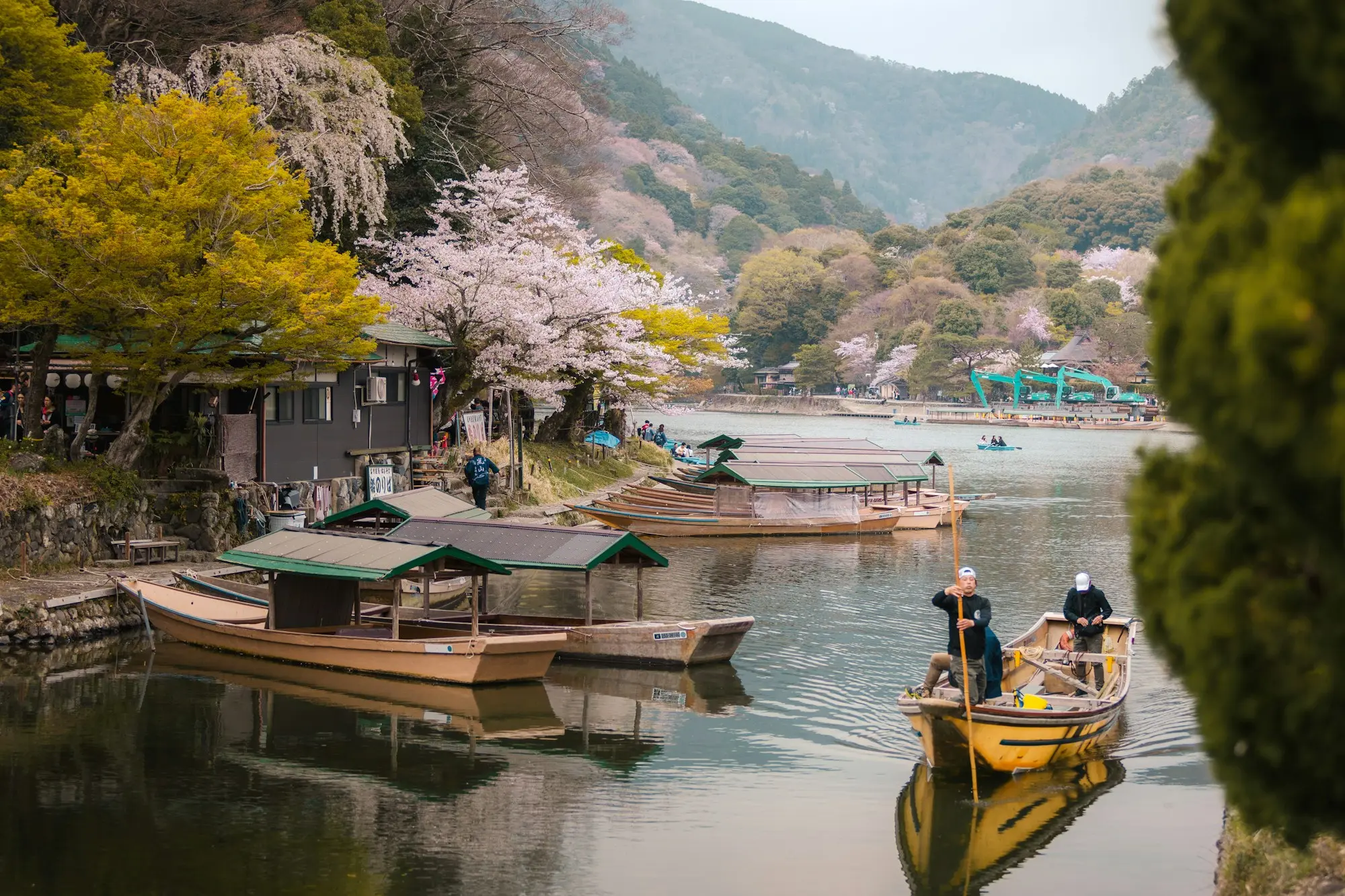
The Arashiyama bamboo grove at first light, before the crowds. A private boat down the Hozu River, about two hours through the gorge with three boatmen poling and steering. Then a smaller boat up the Oi River to Hoshinoya Kyoto, where every room faces the water. Lunch at Shigetsu, the temple kitchen inside Tenryu-ji.
- Days 9-10Ise-Shima, by the sea
A bath above the pearl rafts
The Shimakaze, a premium train with a panoramic front window, runs from Kyoto to the coast in about two hours and forty-five minutes. A short drive to Amanemu, on a hillside above Ago Bay, where every suite has its own hot-spring bath. An early morning at Ise Jingu, Japan's most sacred shrine, then the long, empty afternoon the trip has earned.
- Day 11Tokyo and home
One last counter
Back to Tokyo by train through Nagoya, a last night in the city and the omakase counter, where the chef chooses every course, that you could not get on night one. Haneda is close, and the Delhi and Mumbai flights leave at civilised hours. We keep the final morning for a slow breakfast.
Three ways to honeymoon in Japan
The minimoon — 6 Nights
Tokyo (1) → Mount Fuji and Hakone (2) → Kyoto (3)
For couples with a week. One Tokyo night, Fuji and a ryokan with its own bath, then three Kyoto nights between the old lanes and Arashiyama.
The classic — 11 Nights
Tokyo (2) → Mount Fuji and Hakone (2) → Kyoto (4) → Ise-Shima (2) → Tokyo (1)
Our signature shape: Tokyo, Fuji, Kyoto and Nara, then the sea at Amanemu. Swap Ise-Shima for Azumi Setoda on the Seto Inland Sea if you would rather cycle between islands.
The grand honeymoon — 14 Nights
Tokyo (3) → Mount Fuji and Hakone (2) → Kanazawa and Yamashiro Onsen (2) → Kyoto (4) → Ise-Shima (2) → Tokyo (1)
For autumn couples with time. Adds Kanazawa's gardens and Beniya Mukayu, a ryokan in the hills above Yamashiro Onsen, between Fuji and Kyoto.
What we would plan for the two of you
FUJI FROM CHUREITO PAGODA
The five-storey pagoda above Fujiyoshida, Mount Fuji rising behind it, the town small below. The mountain is most often clear in the early morning, before cloud builds. In spring the slope is pink with cherry blossom; in winter Fuji is white to its shoulders.
THE BATH ON YOUR OWN TERRACE
Late at night at Gora Kadan, the garden dark, the water from the spring at around forty degrees. Your own open-air bath, so you share it, which no public onsen allows. A cold glass of water on the ledge, the steam lifting into the mountain air, and no reason to hurry inside.
NINENZAKA AT SEVEN IN THE MORNING
The stone steps below Kiyomizu-dera, the wooden shopfronts still shuttered, the Yasaka pagoda dark against a pale sky. By ten it is shoulder to shoulder. At seven it is the two of you and a man sweeping his doorstep. We bring a photographer if you want the portraits without the crowds.
THE BAMBOO GROVE AT DAWN
Arashiyama's bamboo grove is on every Japan itinerary, and by mid-morning it is a queue. At first light, from Hoshinoya Kyoto across the river, it is green, tall and almost silent, the stalks creaking in the wind.
MAPLES BY LANTERN AT EIKAN-DO
From about the twentieth of November into early December, Eikan-do in Kyoto opens after dark and lights its three thousand maples. The pond turns into a mirror of red and gold. It is the most romantic hour of the Kyoto autumn, and the reason a late-November wedding should fly to Japan.
A PRIVATE BOAT THROUGH THE HOZU GORGE
A flat-bottomed wooden boat chartered for two, three boatmen with oars and long bamboo poles, sixteen kilometres of rapids, rocks and green gorge from Kameoka down to Arashiyama. About two hours. In autumn the hillsides blaze; in May they are a dense, fresh green.
Honeymoon hotels in Japan we trust
Aman Tokyo
The top floors of the Otemachi Tower, with the lobby on the thirty-third floor under a tall washi-paper ceiling. Rooms are large by Tokyo standards, with deep soaking tubs at the window and the city spread out below. A calm first stop after the overnight flight, close to Tokyo Station for the trains.
Gora Kadan
Our first-choice ryokan for a honeymoon: once a summer villa of a branch of the imperial family, in the hills of Hakone. Book a room with its own open-air hot-spring bath, so you can bathe together. Kaiseki is served in the room. Fuji and Lake Ashi are a short drive away.
Hoshinoya Kyoto
Reached only by boat up the Oi River, twenty-five rooms on the far bank facing the water and Mount Ogura. When the day visitors leave Arashiyama, the valley goes quiet and the hotel has it almost to itself. For a honeymoon, it is the Kyoto stay we put last.
Amanemu
Twenty-four suites and eight villas on a hillside above Ago Bay, where pearl rafts dot the water. Every suite, at ninety-nine square metres, has its own bath fed by the hot spring. Book a Nagi suite for the widest view of the bay. It is the quietest finish to a Japan honeymoon we know.
Zaborin
The winter honeymoon answer. Fifteen villas among birch trees in Hokkaido, each with its own indoor and outdoor hot-spring bath, so you soak with snow falling around you. Kaiseki uses Hokkaido crab and mountain vegetables. Right for a December or January wedding, and for couples who ski.
When to go on your Japan honeymoon
Kyoto's autumn maples, crisp walking weather and warm baths at night. A late-November or early-December wedding flows straight into it. The ryokans for this fortnight book nine to twelve months ahead, so we hold rooms before the wedding venue is confirmed.
Clear skies, Mount Fuji at its sharpest and a bath in the snow at Zaborin or Gora Kadan. Plum blossom from late February. Ideal for January and February weddings. Avoid the New Year week, roughly 29 December to 3 January, when many restaurants and some ryokans close.
Cherry blossom in Tokyo and Kyoto from about the last week of March, then the green, quiet weeks of May. Blossom is a forecast, never a promise. Avoid Golden Week, from about 29 April to 5 May, when Japan travels at home.
June is the rainy season on the main island. July and August are hot and humid, Fuji is usually hidden in haze, and mid-August brings the Obon holidays, when trains and ryokans fill. If summer is your only window, Hokkaido's cool air is the exception we would plan.
Planning a Japan honeymoon from India
Flights from India
Air India and ANA fly nonstop from Delhi to Tokyo Haneda, and Japan Airlines to Narita, in a little over seven hours. From Mumbai, Air India flies to Haneda and ANA to Narita. From Bengaluru, Japan Airlines now flies nonstop to Narita daily. Japan is three and a half hours ahead of India. We prefer Haneda, about thirty minutes from central Tokyo.
Getting around
The bullet train, the shinkansen, is part of the romance: Green Car seats, Japan's first class, and Tokyo to Kyoto in about two hours and fifteen minutes. Luggage goes ahead by overnight courier, so you travel with one small case. Private cars meet you at every station that matters and take you to Fuji, and in Kyoto we walk the old lanes rather than take the crowded buses.
Vegetarian & Jain food
The honest answer: Japan is the hardest country we plan for vegetarians, because fish stock hides in soups, sauces and simmered dishes. The answer is shojin ryori, Buddhist temple cooking with no meat or fish, and ryokan kitchens briefed in Japanese weeks before you arrive. Jain meals need the earliest notice of all.
Pair it with
Bali. Garuda flies daily from Tokyo Narita to Denpasar in about seven and a half hours, and there are nonstop flights from Bali home to Delhi, Mumbai and Bengaluru. Tokyo, Fuji and Kyoto first, then a week of warm sea and a pool villa in Ubud or Uluwatu: the most popular two-country honeymoon we design in Asia.
More for your Japan honeymoon
The places
Pairs beautifully with
What travellers say
“Really amazing experience with their trip planning and in trip assistance. Kriti and Tushika have been very helpful throughout the trip. Always available and providing the best experience throughout. Our best wishes to the entire team”
“TheLuxeTrails made our California vacation effortless. Their attention to detail was impressive — beautiful accommodations, excellent itinerary planning, and genuine flexibility when we decided on an impromptu road trip. They arranged our car within hours and provided local expertise that transformed our trip.”
“We had a great experience in uk . The team is very helpful and they are assisting us till the end of the trip . Overall my experience with luxe trail is amazing”
“Highly personalised trip with great coordination throughout! Definitely recommended”
A first conversation
Tell us a little below. A travel designer replies personally on WhatsApp — no cost and no commitment.
The discovery call
An unhurried call, free of charge, where you do most of the talking: your pace, what you love, the date that matters.
Your proposal, presented
A considered proposal walked through with you — the route, each named hotel, the private moments, and what we would skip.
Tell us about your Japan honeymoon
Your wedding date, how long you have, and what the two of you love. A travel designer reads every enquiry personally and replies on WhatsApp.
Questions, Answered
Do you offer Japan honeymoon packages?
We don't sell fixed packages — every honeymoon is designed from scratch around your dates and the two of you. If you have been comparing Japan honeymoon packages, most follow the same route of Tokyo, a Fuji day trip by coach and Kyoto. We keep those places, give Fuji two nights instead of a day, add a ryokan with its own hot-spring bath, and end by the sea.
Is Japan good for a honeymoon in December?
Yes, especially early December. Kyoto's last autumn colour lingers into the first week, Mount Fuji is at its clearest, and a hot-spring bath on your own terrace makes sense in the cold. Later in December, Hokkaido's snow and a villa at Zaborin are the romantic choice. Avoid the New Year week, when many restaurants and some ryokans close.
How many days are enough for a Japan honeymoon?
Eleven nights is our signature: Tokyo, two nights at Mount Fuji and Hakone, four in Kyoto with Nara, and two by the sea at Ise-Shima, with a last night in Tokyo. Six nights works as a minimoon of Tokyo, Fuji and Kyoto. Fourteen nights adds Kanazawa. Never cut Kyoto below three nights.
Can we see Mount Fuji on a Japan honeymoon?
Yes, and we plan for it. We stay two nights near the mountain, at Hakone, so you have two chances at a clear morning rather than one coach day. Chureito Pagoda and Lake Kawaguchi are about an hour's drive from Hakone, and the boat across Lake Ashi faces Fuji. December to February gives the clearest views; summer haze often hides it.
What is a ryokan, and which is best for a honeymoon?
A ryokan is a traditional Japanese inn: tatami rooms, futon beds, a seasonal many-course dinner served in your room, and a hot-spring bath. Public onsen are separated by men and women, so for a honeymoon we book only rooms with their own open-air bath. Gora Kadan in Hakone is our first choice, and Beniya Mukayu near Kanazawa our favourite for autumn.
Tokyo or Kyoto for a honeymoon?
Both, but give Kyoto more nights. Tokyo is two nights of energy, food and design. Kyoto is the heart of a Japan honeymoon, best in four nights split between the old lanes of Higashiyama and the river at Arashiyama, with a half-day in Nara. Osaka is about fifteen minutes from Kyoto by bullet train, for an evening of street food. Fly into Tokyo, travel one direction, and end somewhere quieter than either.
When is cherry blossom season for a Japan honeymoon?
Usually from about the last week of March into early April in Tokyo and Kyoto, though it is a forecast that moves by a week or more each year. Late November, for Kyoto's maples, follows the Indian wedding season more closely. Avoid June's rains, August's heat and Golden Week.