Japan, designed around you
Fushimi Inari's gates at six in the morning, a private bath on a ryokan balcony in Hakone, a night inside a museum on Naoshima. We design luxury Japan journeys from India for couples, families and the generation travelling together — one direction, one pace, every door opened in advance.
Begin planningOne direction, fewer bases
Japan is the most reliable country we plan. The trains run to the second, the hotels are immaculate, and nobody worries about safety at midnight. That reliability is the trap. Because everything works, travellers try to see everything, and a first Japan itinerary turns into a checklist of temples. The difference in Japan is not the logistics. It is access, timing and pace: the right ryokan night, the shrine before the coaches, the sushi counter that does not take bookings from abroad.
The classic mistake is the loop. Most first trips fly into Tokyo, run to Kyoto and back, and lose half a day on the return. We plan Japan in one direction. Tokyo first, then a night in Hakone, then Kyoto, with bags forwarded overnight by courier so you ride the shinkansen with a small case. The second mistake is Kyoto by day. Kyoto at noon is one of the most crowded places in Asia. At dawn it is still a sacred city. We plan around that.
Japan has never been easier from India. Air India, Japan Airlines and ANA fly nonstop from Delhi to Tokyo, a little over seven hours, and Air India and ANA also fly nonstop from Mumbai. That is shorter than most journeys to Europe, and the time difference is only three and a half hours. From Bengaluru, Chennai and Hyderabad we usually route through Singapore, which also opens Osaka as a gateway for the journey home.
The Japan we design
Tokyo
Three nights, never fewer. We stay high and quiet: Aman Tokyo on the top floors of the Otemachi Tower, Janu Tokyo in Azabudai Hills for families, or the Park Hyatt, reopened in December 2025 after a nineteen-month renovation. The Tokyo we plan is a sushi counter of eight seats, sumo stable practice at seven in the morning, and teamLab with timed entry booked weeks ahead. Shibuya Crossing takes ten minutes. Give it ten minutes.
Hakone and Mount Fuji
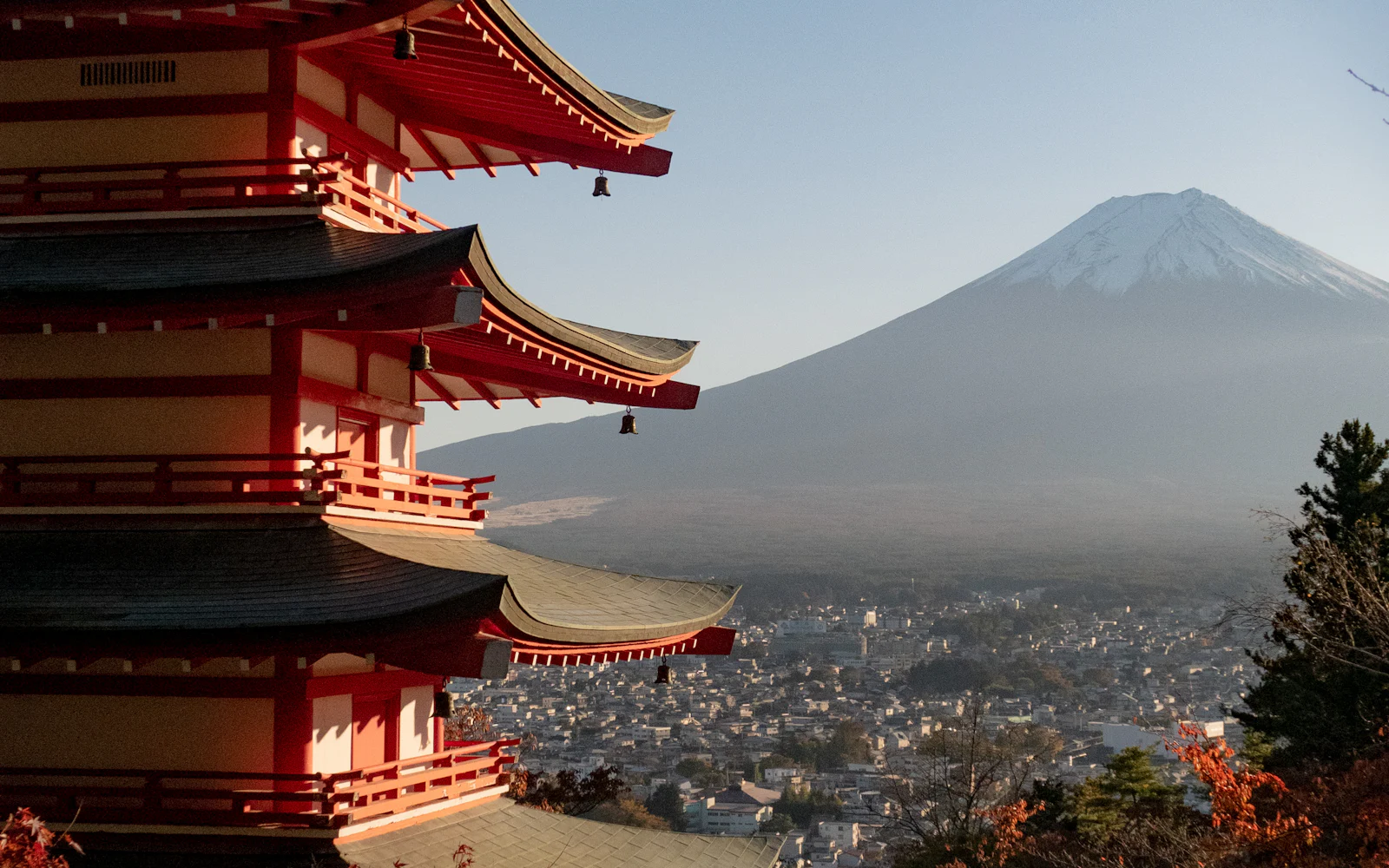
The ryokan night every first trip needs, about ninety minutes from Tokyo. Gora Kadan, the former summer villa of an imperial family branch, is the classic; Hoshinoya Fuji, on the hills above Lake Kawaguchi, is the one with Fuji across the water. Fuji hides behind cloud more often than the postcards admit, so we keep the morning free and go when the sky clears. We skip the tourist pirate ship on Lake Ashi.
Kyoto
The heart of the journey, and three nights minimum. Tawaraya, eighteen rooms and more than three centuries of one family, or Aman Kyoto in a forgotten garden near Kinkaku-ji. Fushimi Inari before seven, Arashiyama before the coaches, and a private maiko dinner arranged through an ochaya introduction. Gion's private lanes have been closed to tourists since 2024 — the right way in is an invitation.
Explore KyotoNaoshima and the art islands
Japan for the traveller who has already seen Kyoto. A shinkansen to Okayama, fifty minutes by local train to Uno, twenty minutes by ferry. Tadao Ando's Chichu Art Museum holds five Monet water lilies under daylight, and his Naoshima New Museum of Art opened in 2025. Sleep at Benesse House and the galleries are yours after the last ferry leaves. Two nights is right.
Explore Naoshima and the art islandsHokkaido
The winter answer for families who have done Switzerland. Niseko's powder from December to February, private ski instructors who speak English, and a food culture of crab, uni and Yoichi whisky. We stay at Zaborin, fifteen villas in the Hanazono birch woods, each with its own hot spring bath indoors and out. In July, the lavender of Furano and cool air make it the summer escape from Honshu's heat.
Journeys we design in Japan
First Japan — 10 Nights
Tokyo (3) → Hakone (1) → Kyoto (4) → Osaka (2)
For a first visit. One direction from Haneda to Kansai, so no day is lost backtracking, with Nara as an easy morning from Kyoto.
Japan Honeymoon — 11 Nights
Tokyo (3) → Hakone (2) → Kyoto (4) → Naoshima (2)
Two ryokan nights with a private open-air bath, Kyoto in the quiet hours, and the art islands last so the journey ends slower than it began.
Japan with Family — 10 Nights
Tokyo (4) → Kyoto (3) → Osaka (3)
For children and grandparents together. Connecting rooms in Tokyo, the shinkansen as an event in itself, Nara's deer, and Universal Studios Japan with Express Passes booked months out.
Winter Japan — 9 Nights
Tokyo (3) → Niseko (4) → Sapporo (2)
For families who ski. Powder in January and February, ending at the Sapporo Snow Festival when the dates line up in early February.
What we would plan for you in Japan
Fushimi Inari at dawn
The vermilion gates at six in the morning, before the first train of tour groups. Mist on the hillside, a fox statue every few steps, a priest sweeping the steps. By nine it is a queue. At six it is a shrine.
Dinner with a maiko in Gion
An evening in a teahouse that does not take strangers. A maiko pours, dances and plays the drinking games that have amused Kyoto for centuries, with an interpreter at the table. It runs on introduction only. We make the introduction.
Sumo morning practice
Seven in the morning, a training stable in Ryogoku. You sit on the floor in silence while the wrestlers drill, sweat and slam into each other a few metres away. No tickets, no stadium — just the sport as it is lived. Children never forget it.
A private tea ceremony
Not the thirty-minute demonstration. A Kyoto tea master in a proper tearoom of tatami and paper screens, a briefed and unhurried hour, an interpreter who understands why the bowl is turned. Most travellers see the ceremony. Our clients understand it.
Shojin ryori at Tenryu-ji
Buddhist temple cooking at Shigetsu, inside the Tenryu-ji complex in Arashiyama. Sesame tofu, seasonal vegetables, no meat and no fish stock, served on lacquer overlooking a 14th-century garden. For vegetarian travellers it is not a compromise. It is the meal of the trip.
The Chichu after the crowds
Tadao Ando's museum is built into a hill so the art is lit only by the sky. Monet's water lilies change colour as clouds pass. We take the first timed entry of the morning, when the Walter De Maria room is nearly empty.
Hotels in Japan we trust
Tawaraya
Eighteen rooms, run by the same family for more than three hundred years. Each room has a name, a garden view and a wooden bath. Nothing is announced and everything is anticipated. There is no reliable waitlist, so we book it as early as anything on the itinerary. Best for couples and older children.
Aman Kyoto
Pavilions in a hidden garden at the foot of the hills near Kinkaku-ji, with moss and stone platforms laid by an obi-textile collector who once planned a museum here. It feels like the countryside, ten minutes from the city. The onsen and the quiet suit couples and multi-generation families equally well.
Gora Kadan
Once the summer villa of a branch of the imperial family, now Hakone's grand ryokan. The rooms we book have their own open-air bath, filled from the hot spring, and kaiseki is served in the room. One night is the minimum; two is better. Best for couples and adults.
Benesse House
A hotel inside a Tadao Ando museum. Rooms in the Museum wing open onto the galleries, and the Oval — reached by a private monorail — sits around a pool of water and sky. After the last ferry, the art belongs to the guests. It sells out early in spring and autumn.
Zaborin
Fifteen villas in birch woods near the Niseko slopes, each with indoor and outdoor hot spring baths. Kaiseki uses Hokkaido crab, dairy and mountain vegetables, and the valets drive you to the lifts. It is the most private winter base in Japan we know.
Planning Japan from India
Flights from India
Delhi is the easiest start. Air India and ANA fly nonstop to Tokyo Haneda, and Japan Airlines nonstop to Narita, a little over seven hours. Air India also flies Mumbai to Haneda nonstop four times a week, and ANA flies Mumbai to Narita. Haneda is thirty to forty minutes from central Tokyo; Narita is closer to ninety. From South India we usually connect through Singapore. We fly into Tokyo and home from Osaka where we can.
Getting around
The shinkansen is the right way to travel. Tokyo to Kyoto takes about two hours and fifteen minutes on the Nozomi, and we book the Green Car on the side of the carriage that faces Fuji. Luggage goes ahead by overnight courier, so you travel light. Private cars handle airports, Hakone and Kyoto's early mornings. The national rail pass rarely suits a luxury journey; reserved seats are better.
Best time to go
Late March to early April for cherry blossom, and mid-November to early December for Kyoto's autumn colour — the two loveliest and busiest windows, which we book nine to twelve months ahead. May and October are our favourite quiet months. December to February is for Hokkaido snow. Avoid Golden Week in late April and early May, the Obon holidays in mid-August, and New Year, when Japan travels at home and many restaurants close.
Vegetarian & Jain food
Honestly, Japan is the hardest country we plan for vegetarians. Fish stock, called dashi, hides in miso soup, simmered vegetables and noodle broths, and a dish with no visible meat is rarely vegetarian. The answer is shojin ryori, the Buddhist temple cuisine, plus kaiseki kitchens briefed weeks ahead and a Japanese-language dietary card we prepare. Jain meals need the most planning; we brief every ryokan at booking and add Indian meals in Tokyo and Osaka.
With children and grandparents
Japan is one of the best family countries we know: safe, clean, punctual and full of wonder for children. The shinkansen is an attraction in itself. Connecting rooms are scarce in Japanese hotels, so we secure them first. For grandparents, we keep to two or three bases, use private cars instead of stations on travel days, and choose ryokans with beds rather than futons when knees matter.
One designer, end to end
A single person owns your journey from the first call to your homecoming. You never re-explain yourself, and there is always one number to call.
Chosen, not defaulted
Every hotel, table and guide is picked for you, and we tell you what to skip, not only what to book.
Every detail handled
Flights, routings, transfers, train seats and restaurant timings. Your only job is to enjoy it.
What travellers say
“Really amazing experience with their trip planning and in trip assistance. Kriti and Tushika have been very helpful throughout the trip. Always available and providing the best experience throughout. Our best wishes to the entire team”
“TheLuxeTrails made our California vacation effortless. Their attention to detail was impressive — beautiful accommodations, excellent itinerary planning, and genuine flexibility when we decided on an impromptu road trip. They arranged our car within hours and provided local expertise that transformed our trip.”
“We had a great experience in uk . The team is very helpful and they are assisting us till the end of the trip . Overall my experience with luxe trail is amazing”
“Highly personalised trip with great coordination throughout! Definitely recommended”
A first conversation
Tell us a little below. A travel designer replies personally on WhatsApp — no cost and no commitment.
The discovery call
An unhurried call, free of charge, where you do most of the talking: your pace, what you love, the date that matters.
Your proposal, presented
A considered proposal walked through with you — the route, each named hotel, the private moments, and what we would skip.
Tell us about your Japan journey
A travel designer reads every enquiry personally and replies on WhatsApp.
Questions, Answered
How many days are enough for a Japan trip from India?
Ten nights is right for a first journey: three in Tokyo, one in Hakone, four in Kyoto and two in Osaka. Seven nights works if we drop Osaka and stay in one direction. Add two nights for Naoshima or four for Hokkaido in winter. Fewer bases, with longer in each, makes the better trip.
What is the best time to visit Japan from India?
Late March to early April for cherry blossom and mid-November to early December for autumn colour in Kyoto. Both need booking nine to twelve months ahead. May and October are quieter and still lovely. Avoid Golden Week in late April and early May, mid-August's Obon holidays and New Year, when domestic travel peaks.
Is there a direct flight from India to Japan?
Yes. Air India and ANA fly nonstop from Delhi to Tokyo Haneda, and Japan Airlines from Delhi to Narita, in a little over seven hours. Air India also flies nonstop from Mumbai to Haneda, and ANA from Mumbai to Narita. From Bengaluru, Chennai and Hyderabad, one stop through Singapore is usually the smoothest.
Is Japan good for a honeymoon?
It is one of the most romantic journeys we plan. A ryokan night with a private open-air bath, kaiseki served in your room, Kyoto in the quiet hours and the art islands of Naoshima. The service is discreet rather than fussy, which couples tend to love. Spring and autumn are the most photogenic seasons.
Is Japan easy for vegetarian and Jain travellers?
It is the hardest country we plan for vegetarians, because fish stock is in most dishes. It is entirely manageable with preparation: Buddhist temple cuisine called shojin ryori, ryokan kitchens briefed weeks ahead, a Japanese-language dietary card, and Indian restaurants in Tokyo and Osaka. Jain meals need the earliest notice.
Is Japan suitable for a family holiday with children?
Very. It is safe, clean and punctual, and children love the bullet train, Tokyo DisneySea, Universal Studios Japan, Nara's deer and sumo practice. The one constraint is connecting rooms, which are scarce, so we secure them first. For grandparents we keep to fewer bases and use private cars on travel days.