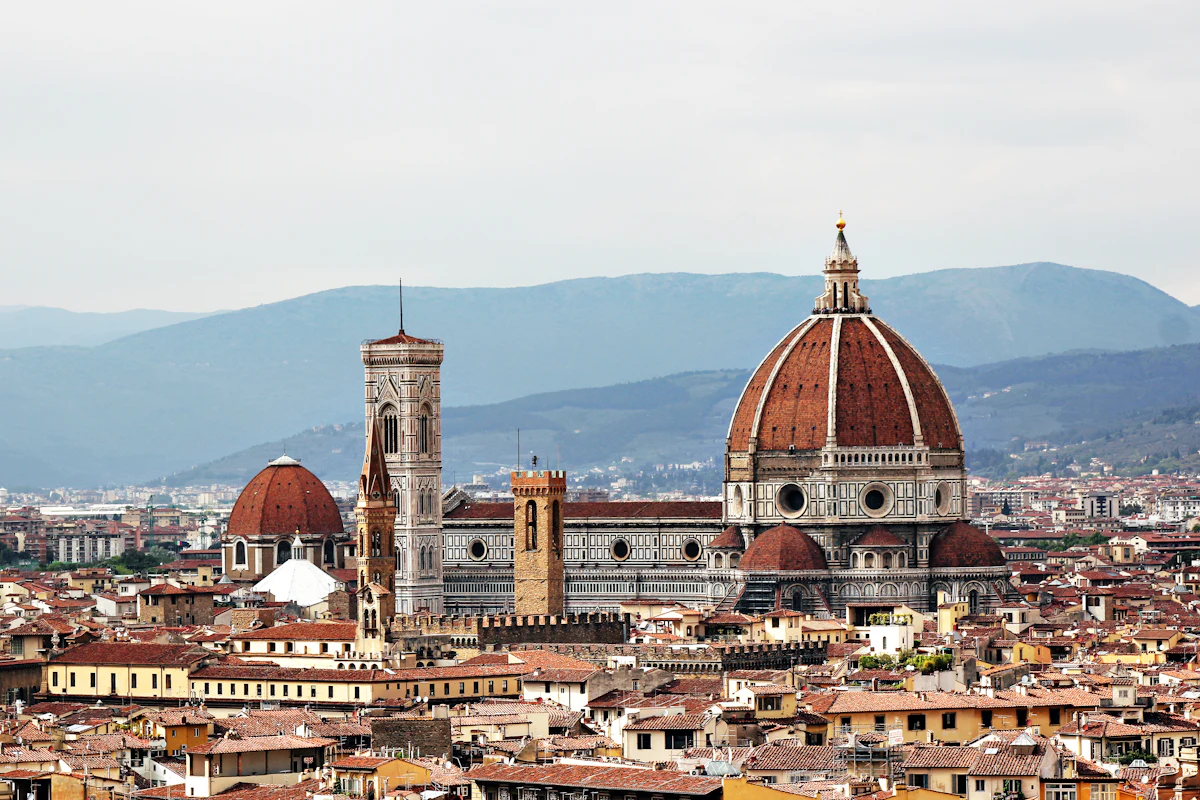
Florence is the Renaissance in a city you can cross on foot in half an hour: Brunelleschi's dome, Michelangelo's David and the Uffizi, then the workshops of the Oltrarno across the river. We give it two or three nights, ideally before the Tuscan countryside.
Florence rewards a plan and punishes the lack of one. The great museums are timed-entry, the queues for David at the Accademia run round the block, and the historic centre is closed to unauthorised cars. So we book everything before you land: the Uffizi with an art historian at the first slot, the Accademia straight after, and the climb up Brunelleschi's dome (463 steps) for the hour when the light is soft. The Vasari Corridor, the raised passage the Medici used to cross the Arno, reopened in December 2024 after years of restoration, and we book it where dates allow. Afternoons belong to the Oltrarno, the artisans' side of the river, where leather, paper and gold-leaf workshops still trade. Sunset is from Piazzale Michelangelo or San Miniato al Monte, above the city. Two nights covers the essentials; three lets Florence breathe.
Timed entries, no queues
The Uffizi, the Accademia and the dome booked in a sensible order before you arrive.
The Vasari Corridor
The Medici's private passage over the Ponte Vecchio, reopened in December 2024.
The Oltrarno
Artisan workshops across the river, visited with someone who knows the owners.
Best time to goApril to June and September to October
Florence, planned from India
Two or three nights in Florence, then the Tuscan countryside; the city is the lesson and the hills are the reward.
Flights from India
Air India flies nonstop from Delhi to Rome several times a week, in about eight and a half to nine hours, and nonstop to Milan. From Mumbai, Bengaluru, Hyderabad and Chennai, one-stop routes through Dubai, Doha or Abu Dhabi take eleven to thirteen hours. Italy needs a Schengen visa for Indian passport holders; apply 45 to 60 days ahead in peak season.
Where we'd stay
Portrait Firenze on the Arno beside the Ponte Vecchio, for suites that feel like apartments. Four Seasons Hotel Firenze for its huge private garden, rare in the centre. Belmond Villa San Michele in Fiesole, a former monastery on the hill, if you would rather look down on Florence than sleep in it.
Getting around
Florence is a walking city. Its historic centre is a restricted traffic zone, so we use private cars only for arrivals and departures. Fast trains link it to Rome in about an hour and a half, Venice in about two and Milan in under two.
Vegetarian & Jain food
Italy is one of the easiest countries in Europe for vegetarians: pasta, risotto, pizza, burrata and grilled vegetables are on every menu. The catches are fish (some Italians assume vegetarians eat it), meat stock in soups and animal rennet in some cheeses. Jain meals are harder, because onion and garlic sit under most sauces, so we brief restaurants in writing before you arrive.
How a few days might unfold
A starting point, not a package — every day is shaped around you.
Arrival by fast train
About an hour and a half from Rome or two from Venice. A walk to the Ponte Vecchio and dinner in the Oltrarno.
The Uffizi and David
The Uffizi at the first slot with an art historian, the Accademia after lunch, and sunset from San Miniato al Monte.
The dome and the river
Brunelleschi's dome in the morning, the Vasari Corridor where dates allow, then an afternoon in the Oltrarno workshops.
Into the countryside
A private car south to the Val d'Orcia or Chianti, about ninety minutes, for the slower half of Tuscany.
Real itineraries through Florence
A Italy honeymoon, designed for two
Lake Como, Venice and Florence, then the Tuscan hills and Positano.
Questions, Answered
How many days do you need in Florence?
Two nights covers the Uffizi, David and the dome; three lets you add the Vasari Corridor, the Oltrarno and a slow evening. Then we usually move you to the Tuscan countryside.
How do we avoid the queues for David?
By booking a timed entry to the Accademia in advance. We book it with the Uffizi and the dome in one sensible order before you travel.
Is the Vasari Corridor open?
Yes. It reopened in December 2024 after restoration, with timed, limited entry. We book it where your dates allow.
Can we visit Florence from Rome as a day trip?
You can, the fast train takes about an hour and a half, but we would not recommend it. Florence needs at least two nights to be more than a queue.
When is the best time to visit Florence?
April to June and September to October. July and August are hot and crowded; December to February is quiet, cold and lovely for museums.