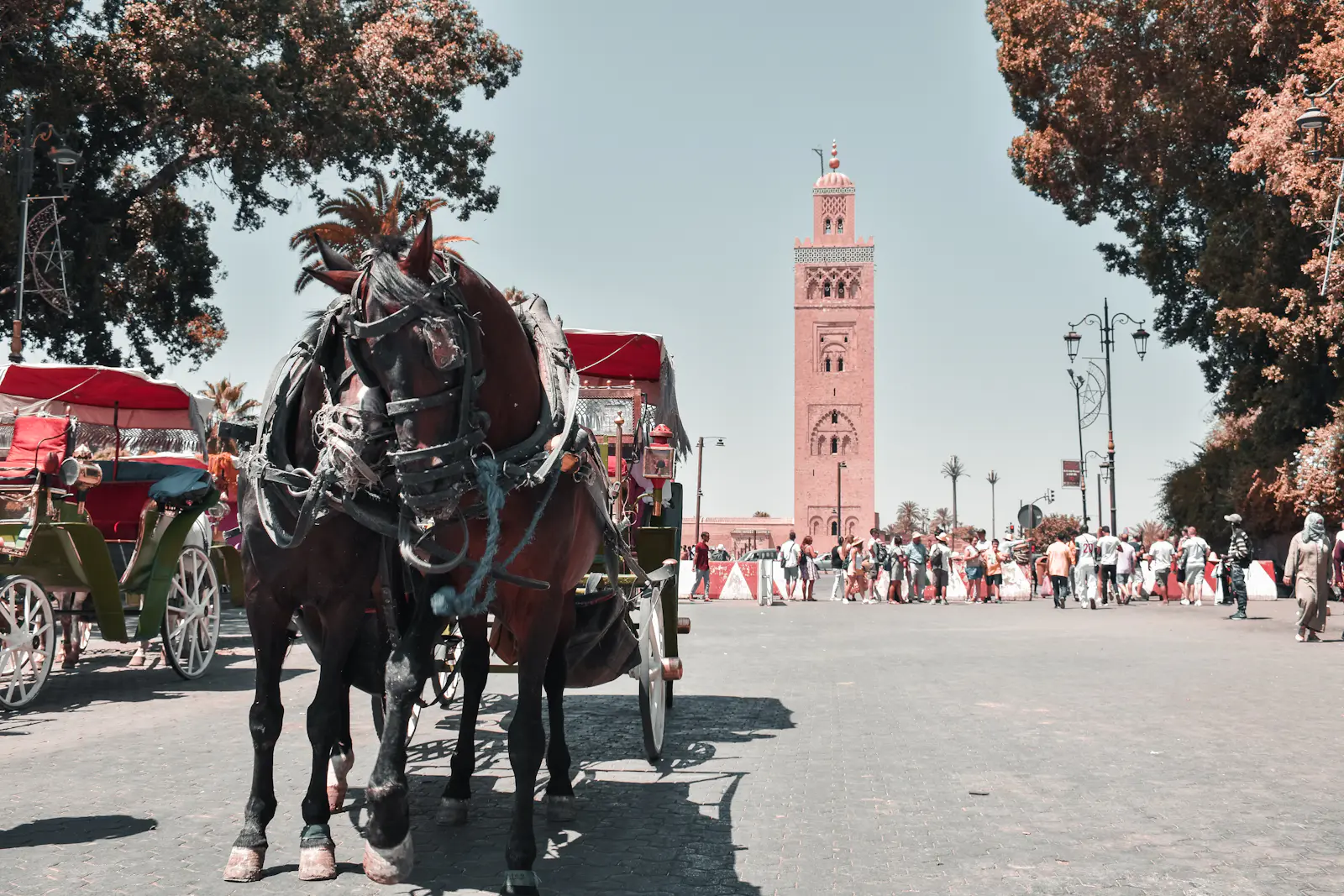
Morocco, designed around you
An imperial city, a mountain kasbah, a desert camp and an Atlantic port, all inside ten days. We design Morocco privately for couples on honeymoon, for families travelling across three generations, and for travellers who want the medina without the touts.
Begin planningA contrast trip, not a tour
Morocco works best as a sequence of contrasts: the noise of the Marrakech medina, then the cool of the High Atlas, then the silence of the desert, then the Atlantic wind in Essaouira. Each one makes the next feel sharper. We build it so that no day is spent only in a car, and so the quietest place comes late in the trip. Ten nights lets you see four of these worlds properly. Seven nights is enough for three.
The classic mistake is the three-day group tour from Marrakech to the Sahara. Merzouga is roughly nine hours by road over the Tizi n'Tichka pass, and those tours drive it twice in three days to a shared camp. If the great dunes matter, we break the drive with a night in the Skoura palm grove and leave the desert towards Fes, not back to Marrakech. If they don't, the Agafay stone desert is under an hour from the city, and for a week-long honeymoon it is usually the better choice.
There are no nonstop flights between India and Morocco. The cleanest routings are Emirates through Dubai or Qatar Airways through Doha into Casablanca, or Turkish Airlines through Istanbul straight into Marrakech, about five hours on the second leg. Allow a long travel day with one connection. We book open-jaw, into Marrakech and out of Fes or the other way round, which removes a six-hour backtrack. Morocco runs four and a half hours behind India, so you land tired, not jet-lagged.
The Morocco we design
Marrakech
Three nights in a riad, never fewer. We walk the souks with a private guide who keeps the touts away, take the first entry of the day at the Majorelle Garden and the Musée Yves Saint Laurent, and book dinner at Al Fassia in Guéliz, run by women since 1987. Royal Mansour and La Mamounia are the great addresses; Amanjena is calm outside the walls.
Explore MarrakechThe High Atlas & Agafay
An hour south, the High Atlas is walnut groves, terraced Berber villages and Toubkal, North Africa's highest peak at 4,167 metres. We base clients at Kasbah Tamadot near Asni and walk by mule to a family lunch in a village. In the other direction, the Agafay is a rocky, lunar desert with camps like Scarabeo, forty kilometres from the medina.
Explore The High Atlas & AgafayFes
Fes el-Bali is the deeper medieval city: thousands of lanes and no cars, and the Al Qarawiyyin mosque and university, founded in 859. It is less polished than Marrakech and far more rewarding for travellers who care about craft. Two nights minimum, a guide always. We stay at Riad Fès, thirty rooms inside the old city, and send clients to Chefchaouen only as a long day out, not a base.
The Sahara at Merzouga
The dunes of Erg Chebbi rise to around 150 metres above the plain, and they are the Sahara people picture. We get there properly: Marrakech over the Tizi n'Tichka to Aït Benhaddou, a night or two at Dar Ahlam in Skoura, then on through the Dadès to a private camp in the dunes. Never a shared camp, and never the drive in a single day.
Essaouira
Two and a half to three hours west of Marrakech, Essaouira is ramparts, blue fishing boats and an Atlantic wind that keeps it around 22 to 26°C in high summer. It is not a beach holiday; the wind sees to that. It is seafood at the port, argan groves, a slow medina and the rooftop pool at Heure Bleue Palais. The right final chapter after the desert.
Journeys we design in Morocco
First Morocco — 10 Nights
Marrakech (3) → Skoura (2) → Merzouga (1) → Fes (3) → Casablanca (1)
For travellers who want the real dunes and both great medinas. We drive east across the Atlas with stops, fly or drive out of Fes, and never retrace a road.
The Morocco Honeymoon — 7 Nights
Marrakech (3) → Kasbah Tamadot, High Atlas (2) → Agafay desert camp (2)
Riad courtyards, then mountain air, then two nights under the desert stars, with no transfer longer than about an hour. A sunrise balloon over the Agafay fits on any morning.
Morocco with Family — 8 Nights
Marrakech (3) → High Atlas (2) → Agafay (1) → Essaouira (2)
Short drives, a private riad with its own cook, camel rides and quad bikes in the Agafay, and the cool Atlantic to finish. Works for grandparents and young children together.
What we would plan for you in Morocco
A balloon over the Agafay at sunrise
Lift-off in the dark, then the Atlas turning pink across the stone desert as the sun comes up. We book a private basket, not the shared one, and a Berber breakfast laid out where you land, with mint tea poured from height.
Majorelle before the gates open to the crowd
The cobalt walls and cactus garden that Yves Saint Laurent and Pierre Bergé saved, at the first entry of the morning when the paths are quiet. Then the Musée Yves Saint Laurent next door, with a guide who knows the couture as well as the garden.
Lunch in a Berber household in the High Atlas
A mule path from Kasbah Tamadot through walnut groves to a village family our ground partner has worked with for years. Bread from a clay oven, a vegetable tagine cooked for you, and the valley falling away below the terrace.
A private night in the dunes of Erg Chebbi
A camel walk into the dunes at five, the light going from gold to rose, and a camp set only for you: your own tent, your own fire, drums after dinner and then nothing. Winter nights fall near freezing, so we choose camps with real heating.
Master craftsmen of Fes
Not the tannery photo stop. A morning in workshops where zellige is still cut by hand, a brass engraver and a weaver, arranged through people who know them. Commission a piece if you like; we handle shipping it to India.
A hammam the proper way
The traditional Moroccan bath, steam, black soap and a long, firm scrub, done at the spa of Royal Mansour or La Mamounia rather than a tourist bathhouse. We pre-book; the good slots go weeks ahead in peak season.
Hotels in Morocco we trust
Royal Mansour
Fifty-three private riads instead of rooms, each with its own courtyard and rooftop, built by craftsmen from across Morocco. Staff move between riads through tunnels beneath the gardens, so you rarely see service happen. Rooftop plunge pools mean we brief families with toddlers carefully.
Kasbah Tamadot
Sir Richard Branson's mountain retreat, fully reopened in 2024 after the 2023 earthquake, with six new riads that each have a private pool and a rooftop hot tub. The valley view from the pool is the point. In summer it runs about ten degrees cooler than Marrakech.
Scarabeo Camp
A small camp of white canvas tents, about forty kilometres from the medina, kept deliberately intimate. Lanterns at dinner, the Atlas on the horizon, and silence after dark. The answer for couples who want a desert night without the long drive.
Dar Ahlam
A restored nineteenth-century kasbah with no menus and no fixed schedule: each meal appears somewhere new, a candlelit courtyard one night, a palm-grove table the next. We brief the house on the couple before arrival, because that is where its magic comes from.
Riad Fès – Relais & Châteaux
About thirty rooms and suites in a historic house inside the old city, each one laid out differently, with a spa and a rooftop over the medina. It puts you a ten-minute walk from Al Qarawiyyin, which in Fes is everything.
Planning Morocco from India
Flights from India
No nonstop flights yet. Emirates via Dubai and Qatar Airways via Doha reach Casablanca, about eight and a half hours beyond the Gulf. Turkish Airlines via Istanbul lands directly in Marrakech, about five hours from Istanbul. Casablanca to Marrakech is two and a half to three hours by road. We book open-jaw so you never backtrack.
Getting around
A private driver-guide in a 4x4 beyond Marrakech is essential. The High Atlas and the Agafay are about an hour away, Essaouira two and a half to three. Merzouga is around nine hours, so we split it in Skoura. Marrakech to Fes is six and a half to seven hours by train.
Best time to go
March to May and late September to mid-November are prime. December to February is clear and bright with snow on the Atlas, but desert nights drop near freezing. Avoid June to August for Marrakech and the desert, when it reaches 45°C; in summer we send clients to Essaouira and the mountains.
Vegetarian & Jain food
Vegetarian is easy: vegetable tagines, couscous, zaalouk and fresh bread, and we brief kitchens that no meat means no meat stock. Jain is harder. Buffets will not manage it; an exclusive-use riad with its own cook will, with our written brief. Marrakech has a few Indian restaurants for a mid-trip comfort meal.
With children and grandparents
Most travel days are one to three hours. Children love the camels, quad bikes and souks in short doses, and an exclusive-use riad gives three generations a house of their own. For grandparents we skip the long Sahara drive and keep medina walks to ninety minutes.
One designer, end to end
A single person owns your journey from the first call to your homecoming. You never re-explain yourself, and there is always one number to call.
Chosen, not defaulted
Every hotel, table and guide is picked for you, and we tell you what to skip, not only what to book.
Every detail handled
Flights, routings, transfers, train seats and restaurant timings. Your only job is to enjoy it.
What travellers say
“Really amazing experience with their trip planning and in trip assistance. Kriti and Tushika have been very helpful throughout the trip. Always available and providing the best experience throughout. Our best wishes to the entire team”
“TheLuxeTrails made our California vacation effortless. Their attention to detail was impressive — beautiful accommodations, excellent itinerary planning, and genuine flexibility when we decided on an impromptu road trip. They arranged our car within hours and provided local expertise that transformed our trip.”
“We had a great experience in uk . The team is very helpful and they are assisting us till the end of the trip . Overall my experience with luxe trail is amazing”
“Highly personalised trip with great coordination throughout! Definitely recommended”
A first conversation
Tell us a little below. A travel designer replies personally on WhatsApp — no cost and no commitment.
The discovery call
An unhurried call, free of charge, where you do most of the talking: your pace, what you love, the date that matters.
Your proposal, presented
A considered proposal walked through with you — the route, each named hotel, the private moments, and what we would skip.
Tell us about your Morocco journey
A travel designer reads every enquiry personally and replies on WhatsApp.
Questions, Answered
What is the best time to visit Morocco from India?
March to May and late September to mid-November, when days sit between 20 and 30°C. December to February is lovely but cold at night in the desert. Avoid June to August for Marrakech and the Sahara. Christmas in Marrakech books out nine to twelve months ahead.
How many days do you need for a Morocco trip?
Seven nights covers Marrakech, the High Atlas and the Agafay without rushing. Ten nights adds the Sahara at Merzouga and Fes, our usual first Morocco itinerary. Twelve brings in Essaouira. With fewer than seven, we would drop the desert rather than race to it.
Is Morocco good for a honeymoon?
It is one of our favourites: a private riad in Marrakech, a mountain kasbah, and a desert camp with no one else around. It is closer than the Americas, the time difference is gentle, and privacy is easy to arrange at every stop.
Agafay desert or the Sahara at Merzouga?
The Agafay is a stone desert without big dunes, under an hour from Marrakech. Merzouga is the Sahara of sand dunes, around nine hours by road. For a seven-night honeymoon the Agafay usually wins. If the dunes matter, we plan Merzouga properly, with a night in Skoura on the way.
Is Morocco comfortable for Indian families?
Yes, with planning. The main irritation is pushy touts in the medinas, which a private guide removes entirely. Food is mild and vegetarian dishes are easy. We keep drives short and choose riads the family can book for itself alone.
Are there direct flights from India to Morocco?
Not at present. The usual routes are Emirates via Dubai or Qatar Airways via Doha to Casablanca, or Turkish Airlines via Istanbul into Marrakech. Expect one connection and a long day. We plan the routing from Mumbai, Delhi or Bengaluru so the first night is easy.